 Marketing Team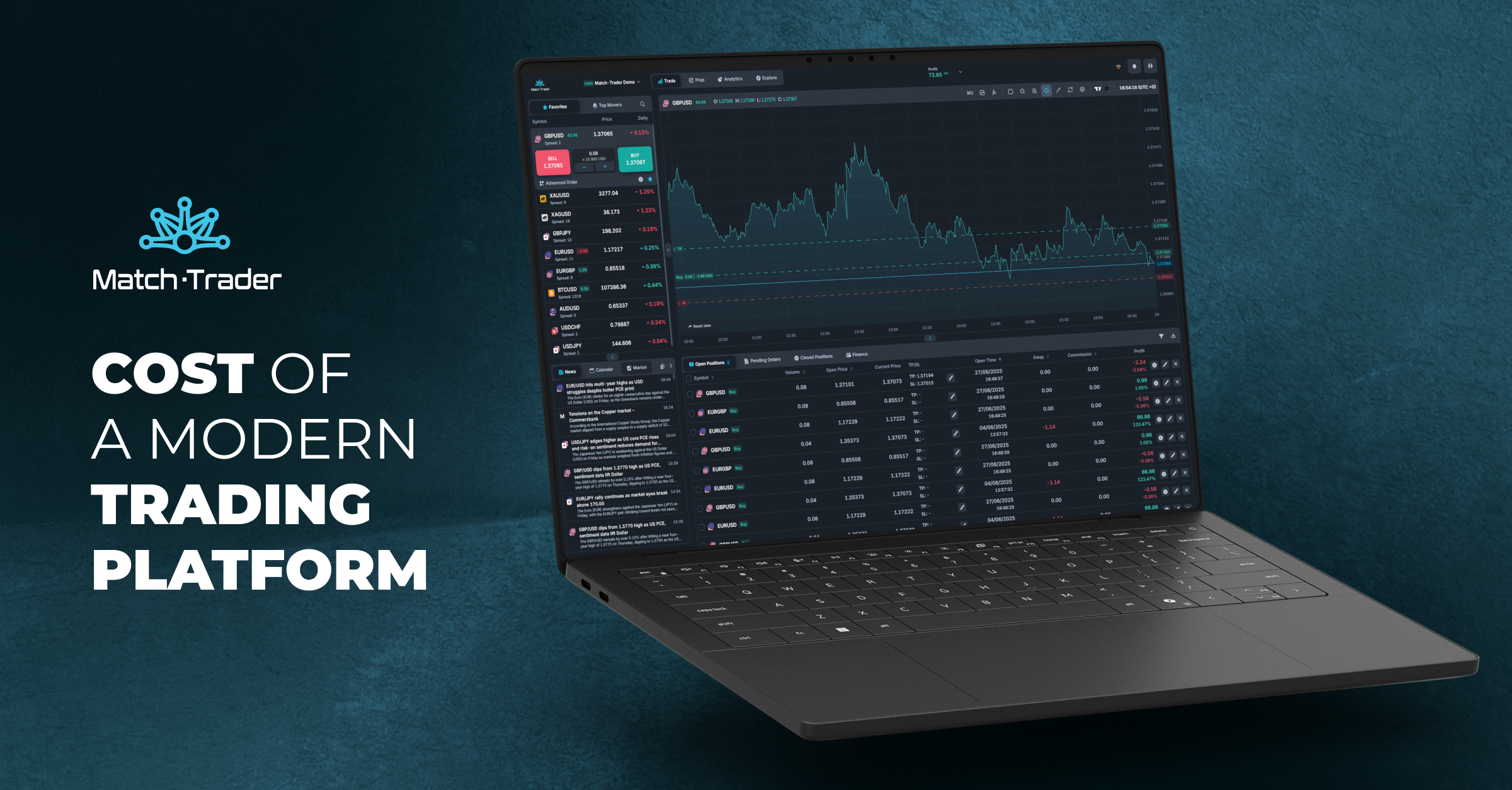
- White-label and server licenses follow different pricing structures; the right model depends on your operational needs and growth trajectory.
- Hidden costs such as bridge setup, CRM integration, and compliance tooling frequently exceed the base platform fee.
- The absence of B-Book turnover fees and a per-account pricing model change the unit economics considerably at higher volumes.
- Total forex broker setup cost depends on your model (FX/CFD, prop, or hybrid) as much as on which platform you choose.
What does a trading platform cost in 2026? The answer depends on your licensing model, your operational requirements, and which costs you’re tracking beyond the headline fee. This breakdown covers the main models, the real numbers, and the costs most brokers miss.
Trading Platform Licensing Models: White Label vs Server
Broker trading platforms are typically available under two commercial structures.
White label
A branded front-end environment running on the vendor’s infrastructure. Lower barrier to entry, with infrastructure management handled by the vendor. The typical entry point for most new brokers.
Server license
The broker takes ownership of the back-end technology, hosting and operating it independently or through a managed arrangement. Carries a higher monthly fee and requires greater operational capability, but gives you more control and room to customize as you grow.
Most brokers launching for the first time begin with a white label and migrate to a server license as account volumes increase. The choice between the two is not purely a budget decision; it reflects how much operational control you want and how fast you expect to grow.
White-Label Trading Platform Pricing in 2026
Match-Trader’s white-label packages start at $2,500 per month for the Basic tier, with a Turnkey tier available at $4,000 per month that includes additional features out of the box. Both are structured on a per-account basis and have no B-Book turnover fees.
The Basic white label covers the core platform (mobile, web, and desktop with TradingView charts), default cloud hosting, a data feed, a liquidity connection, Google/Discord sign-in, a calendar, market news, and 24/7 broker support.
Features such as Social Trading, PAMM, the IB Portal, Cashback Module, KYC with AI pre-check, and the Bonus System are available as add-ons at the Basic level but are also included in the $4,000-per-month Turnkey package.
Brokers comparing white-label platform pricing across vendors should build a full cost stack that accounts for which components are bundled at each tier and which cost extra, because what is included versus what requires an add-on varies considerably between providers and within the same provider’s pricing tiers.
Server License Trading Platform Cost and What It Includes
Match-Trader’s server license starts at $5,000 per month. Like the white-label tiers, pricing is structured on a per-account basis, with no B-Book turnover fees, and default cloud hosting is included.
The server license opens up capabilities that white-label arrangements generally restrict. These include full control over the setup, the ability to create and manage your own white-labels under your main license, on-premises server hosting as an option, access to all databases and APIs, and custom front-end development.
CRM features such as Social Trading, PAMM, KYC with AI pre-check, and the Bonus System are available as add-ons at the Server level, just as they are at the Basic white-label tier. The Server license upgrade is primarily about infrastructure control rather than feature bundling.
The transition from white label to server license is a move that the fastest-growing brokers tend to make within one to two years, so it is worth planning for at launch, even if the white label is the right starting point.
Hidden Costs in Forex Broker Platform Setup
The base platform fee is what brokers budget for. The costs that arrive afterward are the ones that create friction. The most common unexpected line items are as follows.
Bridge connectivity routes order flow between the platform and the liquidity provider; it is a separate cost with most vendors. CRM setup and integration, even with pre-built connectors, takes time and sometimes custom development. Payment processing for deposits and withdrawals is rarely included in the base platform fee.
Compliance tooling for KYC, AML monitoring, and reporting varies among vendors in what is bundled. Any front-end or back-end customization beyond standard configuration is an additional cost.
Match-Trader addresses a significant portion of this through its open ecosystem, which includes pre-built integrations with CRM providers, bridge vendors, and payment processors. The Turnkey white-label package at $4,000 per month bundles the most significant of these components: a built-in CRM at no additional cost, along with AI-powered KYC pre-checks and multi-channel communication integrations that you would otherwise need to source and integrate separately. Pre-built integrations reduce the custom development costs brokers incur when connecting a new platform to an existing operational stack and reduce time-to-market.
Total Forex Broker Setup Cost
A broker launching on a white-label platform with an integrated CRM, a standard bridge setup, and no B-Book turnover fees is looking at monthly platform costs that are lower than those of an equivalent setup on a legacy platform.
The absence of B-Book turnover fees changes the long-term cost calculation for brokers running hybrid booking models at volume. For high-volume operators, that single factor alone can outweigh a competitor’s lower headline monthly fee. Because Match-Trader’s pricing is structured on a per-account basis rather than on turnover, costs remain predictable as trading volume scales.
The most accurate total cost picture comes from building a full stack breakdown before choosing a vendor: platform fee (monthly base plus per-account charges), bridge setup and ongoing fees, CRM configuration and licensing, hosting costs if opting for on-premise infrastructure beyond the default cloud hosting, compliance and payment tooling, and ongoing support and development.
Brokers who do this exercise before vendor selection make different decisions than those who compare platform fees in isolation.
Match-Trader offers white-label pricing starting at $2,500 per month (Basic) and $4,000 per month (Turnkey), with server licensing from $5,000 per month. All tiers are priced per account, with no B-Book turnover fees. The Turnkey tier includes CRM in the monthly fee. Across all tiers, prebuilt integrations with bridge and payment partners reduce setup time and custom development costs, though those third-party services incur separate fees.
Contact the team to get a cost breakdown tailored to your brokerage model.
FAQ
What is the typical cost of a white-label trading platform for a broker?
White-label platform pricing varies significantly across vendors. Match-Trader’s Basic white-label package starts at $2,500 per month, with a Turnkey option at $4,000 per month that bundles additional features, including a built-in CRM, Social Trading, PAMM, and KYC with an AI pre-check. All tiers are priced on a per-account basis. The more relevant comparison is the full monthly cost stack, including CRM, bridge, and any components not bundled at your chosen tier, rather than the headline monthly figure alone.
What is the difference between a white label and a server license for a trading platform?
A white-label solution provides the broker with a branded front-end environment running on the vendor’s infrastructure, with lower monthly costs and operational management handled by the vendor. A server license gives the broker greater control over the back-end technology, including the ability to create sub-white-labels and host on-premise, at a higher monthly fee. Most brokers start with a white-label license and migrate to a server license as volume grows.
What are the hidden costs when setting up a forex brokerage platform?
The most common unexpected costs are bridge connectivity fees, CRM setup and integration, compliance tooling, payment processing, and custom development work. Brokers who choose a platform with a wide pre-built ecosystem of integrations, or who opt for a higher-tier package that bundles these components, typically avoid a significant portion of these costs. Building a full cost stack before selecting a vendor gives a more accurate picture of the total forex broker setup cost than comparing monthly platform fees alone.