 Marketing Team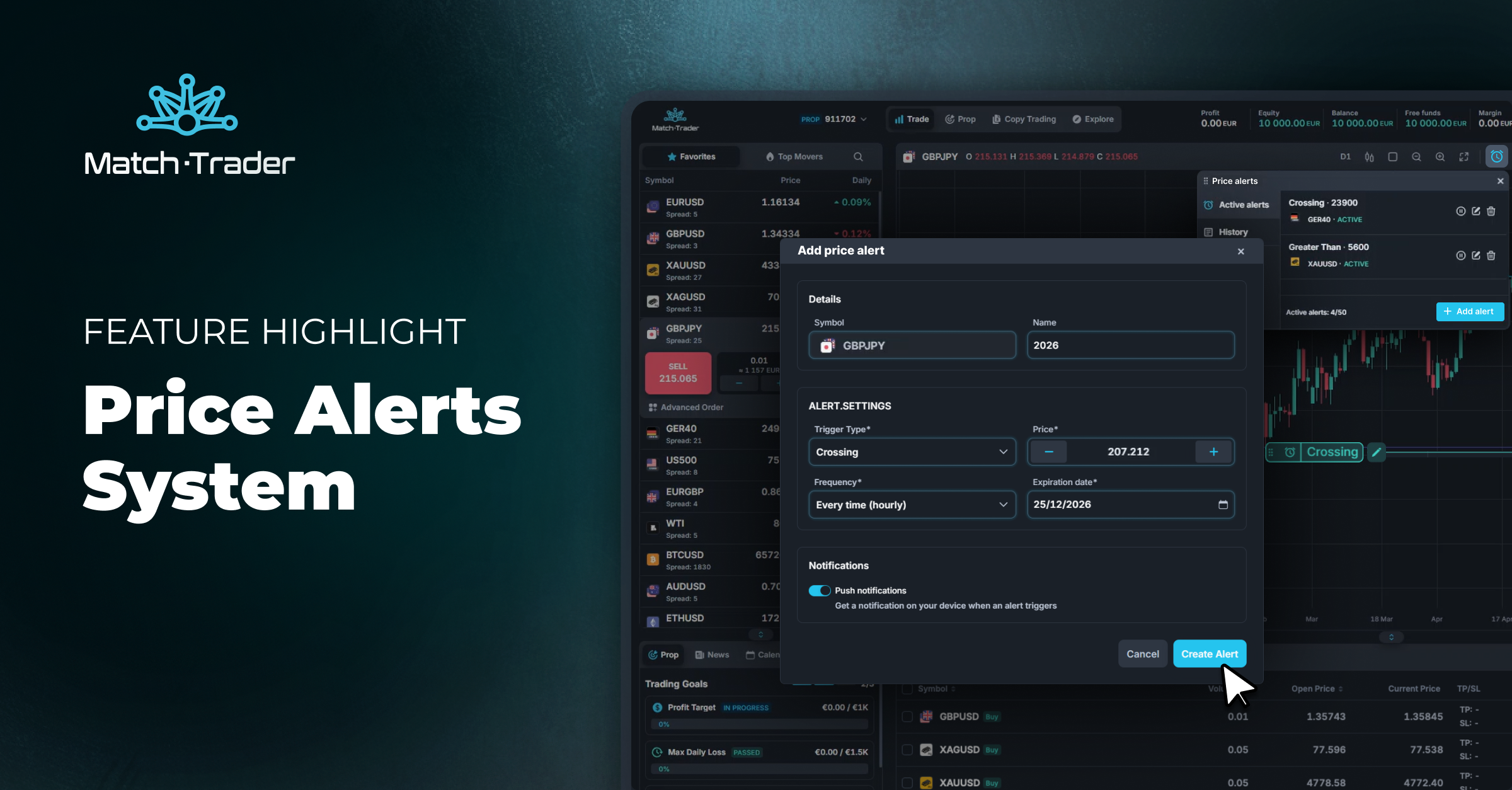
This month’s release combines platform updates with risk and liquidity tooling updates to bring advanced trading workflow improvements, stronger compliance controls, and more precise execution management across Match-Trader. Together, they create a more intuitive, controlled, and consistent day-to-day experience for traders, brokers, and internal teams alike. Key updates include:
- Price Alerts System – monitor price movements across instruments and receive notifications when defined thresholds are reached
- Trading Actions During Closed Sessions – place pending orders and manage TP/SL levels outside active market sessions
- Guided Onboarding for Geolocked Countries – collect residency and citizenship declarations during registration to support jurisdiction-based access controls
- Indicator Templates – let traders apply standardized indicator logic without changing the full chart layout
- Phase Configuration and First Withdrawal Condition – give admins controlled first-withdrawal eligibility across funded-account phases
- Streamed Historical Data in MTR Manager – review Orders, Ledgers, and Closed Trades immediately while the rest continues loading in the background
- Date and Time Range Filtering in MTR Manager – narrow searches by exact date and time on every time column for precise investigations, reporting, and audits
- VWAP Slippage in Orders Summary – surface a volume‑weighted slippage metric in the Orders Summary for a clearer, filter-synced view of execution quality
- Consistent Outcomes Regardless of Swap Direction – deliver predictable swap markup behavior for brokers and traders
- Long-Only/Short-Only Targeting – introduce direction-aware routing rules for controlled execution and liquidity distribution
- Mirroring Options and Reverse Mirroring Safeguards – support automated hedge replication while helping maintain system stability
Price Alerts System
With the newly released functionality, staying ahead of the market no longer means traders must keep a constant watch over their open charts. The new Price Alerts system enables precise, condition-based monitoring across all instruments. Users can define a price threshold, select whether the alert triggers on a cross above or below that level, and choose their preferred notification channel – mobile push notifications or in-app toast notifications.
A dedicated alerts management view includes active alerts alongside a full alert history, capturing what triggered each alert, when, and at exactly what price. This gives traders the context they need to calibrate thresholds against real market behavior over time. Alerts are fully integrated across desktop and mobile – once configured, they notify the trader across devices, whether the alert was created on desktop or mobile.
Benefits:
- Fewer missed opportunities: An always-on monitoring layer eliminates the need for constant chart supervision, giving traders confidence that relevant price movements are captured and can be responded to in time.
- Stronger platform competitiveness: Intelligent alerting infrastructure delivers professional-grade monitoring, driving higher trader engagement and platform traffic, while equipping brokers with tools for long-term retention.
- Faster query resolution: A built-in alert history serves as a reliable audit trail, enabling support teams to investigate and resolve trigger-related questions with precision – eliminating any dependency on trader recollection.
Trading Actions During Closed Sessions
Market opportunities don’t pause for session hours, and neither does a trader’s ability to act on them. Traders can place pending orders and modify Take Profit and Stop Loss levels on existing positions outside active market sessions, including weekends and after-session periods.
Orders are queued for execution at session open, while risk parameters remain fully editable – adding, adjusting, or removing levels without dependency on live market access.
Benefits:
- Fully prepared strategies: Trading preparation beyond market hours becomes a seamless part of the workflow, allowing traders to arrive at every session with setups pre-built and ready for immediate execution.
- Uninterrupted risk control: Continuous management of TP/SL levels ensures traders are never forced to leave positions exposed overnight simply because the session has closed.
- A bridged competitive gap: Meeting the expectation of off-hours order preparation equips brokers with the capability that serious traders increasingly consider a baseline.
Guided Onboarding for Geolocked Countries
A guided questionnaire has been introduced for registrations from geolocked locations, collecting residency and citizenship declarations at the right time during onboarding. When access originates from a restricted jurisdiction, trading can be blocked accordingly, while all submitted declarations are surfaced in CRM and Platform Config for streamlined verification by the relevant team.
Benefits:
- A repeatable, auditable eligibility workflow: Jurisdiction-based compliance requirements are met with consistency, giving brokers in regulated markets a structured, documented process that scales without added operational burden.
- Faster, more confident reviews: With declarations centralized and visible directly within internal systems, compliance teams eliminate the manual chasing that typically slows down verification, turning a resource-intensive process into a streamlined one.
Indicator Templates
For traders who rely on a defined stack of indicators, consistency across charts is non-negotiable. The new Indicator Templates allow any curated combination of indicators, complete with their individual configurations, to be saved and applied to any chart at the click of a button. Each trader’s template library is kept separate from Chart Templates, purpose-built for those who want to standardize their indicator logic without overwriting the entire chart layout.
Benefits:
- Consistent multi-indicator setups: The manual work and configuration errors are eliminated entirely, giving traders a reliable, single-action way to apply their full indicator logic.
- Separation of indicator logic and chart visuals: Advanced users can manage their analytical framework and chart aesthetics independently.
Phase Configuration and First Withdrawal Condition
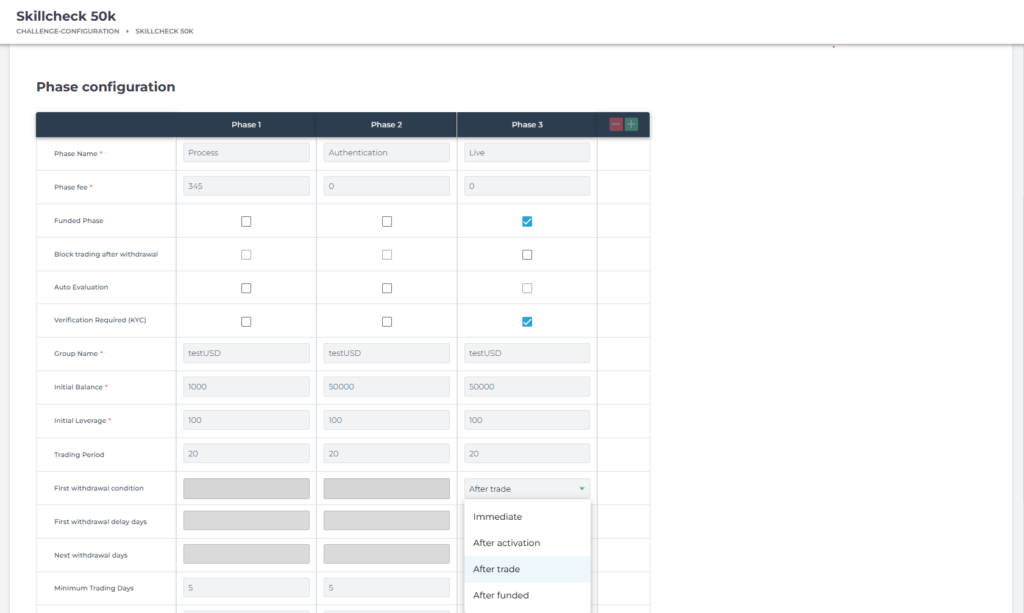
The new First Withdrawal Condition has been added to phase configuration for funded accounts, allowing administrators to define when a trader’s first withdrawal becomes available. The configuration supports immediate access, access after funded activation, access after the first trade, or access after a configurable funded-phase delay, creating a structured, rules-based payout framework.
Benefits:
- Full control over payouts: Administrators gain the ability to enforce the withdrawal policy consistently across every account and phase, strengthening disciplined risk management.
- Transparent withdrawal eligibility: Clearly defined criteria give traders a clear understanding of when and how withdrawals become available, reducing uncertainty and support queries.
- Standardized withdrawal rule enforcement: Operations teams are freed from case-by-case manual review, with withdrawal rules applied uniformly and predictably across all accounts and phases.
Streamed Historical Data in MTR Manager
MTR Manager now delivers historical data through incremental streaming, replacing the previous all-or-nothing loading model with a faster, batched delivery process from the report service. Instead of waiting for the entire dataset to load before any information becomes visible, brokers see each batch rendered as soon as it arrives from the underlying store.
This means Orders, Ledgers, and Closed Trades become available for review while the remaining results continue loading in the background. A clear loading indicator remains visible until the full set is complete, giving users transparency without interrupting their workflow. The improvement applies to both general and detailed views across all three tabs, removing the long blank waiting periods that previously followed heavier filter queries.
Benefits:
- Near-immediate access to trading history: Brokers begin reviewing key trading records within seconds, turning previous loading delays into productive analysis time.
- Faster operational investigations: Operations and dealing-desk teams gain shorter turnaround times when reviewing closed trades, validating ledger movements, or completing end-of-day checks.
- Smoother performance on large queries: Heavier historical data requests no longer disrupt workflow continuity, giving brokers the freedom to work with broader filters without sacrificing usability.
Date and Time Range Filtering in MTR Manager
Precise date-and-time filtering across every time column in MTR Manager gives brokers far more control over how they search, review, and analyze operational data. Rather than being limited to calendar-date filtering, users can narrow results down to a specific hour or minute, making investigations and reporting significantly more accurate.
The new “from” and “to” inputs accept full timestamps and default to full history when left empty, preserving flexibility for both broad reviews and highly specific queries. The control has been rolled out consistently across every Manager tab with a time column, creating a unified filtering experience throughout the application.
Benefits:
- Minute-level investigation accuracy: Operations teams isolate exact incident windows faster, accelerating trade-routing, execution, and post-event analysis.
- Stronger intraday reporting control: Dealing desks gain the granularity needed to compare activity across specific market windows, sessions, or operational periods.
- More focused compliance reviews: Audits become more efficient by targeting the exact hours under review instead of requiring broad full-day extracts.
VWAP Slippage in Orders Summary
The Orders Summary table in MTR Manager includes a dedicated VWAP Slippage column, included in both the general Orders view and the per-account Orders view. This gives brokers and dealing teams a clearer, volume-weighted view of execution quality across the selected order set.
The figure is calculated as the volume-weighted average of slippage across displayed orders, aligned with the way row-level slippage is already presented. Orders with empty slippage values, where no base price is present, are excluded from both the numerator and denominator to ensure the aggregate reflects only meaningful execution data. When the current filters return no qualifying orders, the summary displays “—” instead of zero, avoiding misleading interpretation.
Benefits:
- Clearer execution-quality insight: Dealing desks gain an immediate, volume-weighted view of slippage across the orders under review, making performance assessment faster and more meaningful.
- Stronger account-level comparison: Brokers reviewing individual trading accounts see the same VWAP Slippage logic in the account-level summary, supporting like-for-like comparisons.
- Real-time analytical alignment: Filters and the aggregate stay in sync, as narrowing the Orders view updates VWAP Slippage immediately to reflect the new selection.
Consistent Outcomes Regardless of Swap Direction
Swap markup logic has been rearchitected to ensure deterministic, directionally consistent outcomes. Positive markups now reliably benefit the broker, while negative markups reliably benefit the trader – regardless of whether the underlying swap value changes sign. This eliminates the edge-case inconsistencies that previously introduced financial unpredictability at the instrument level.
Benefits:
- More reliable profitability behavior: Brokers can count on positive swap markups to generate the expected revenue contribution without exposure to unintended sign flips.
- Trustworthy pricing: Traders receive transparent, predictable treatment of negative markups, reinforcing trust in the platform’s pricing integrity.
- Reduced operational and financial risk: Admins benefit from the elimination of ambiguous calculation outcomes from swap-related configurations, removing a meaningful source of edge-case exposure from daily operations.
Long-Only/Short-Only Targeting
Execution routing can now be configured with directional awareness: routing rules support long-only, short-only, or combined trade directions, enabling more controlled execution and liquidity routing strategies.
Benefits:
- Tighter, policy-aligned execution control: Direction-aware routing gives dealing and risk teams the confidence that every trade is handled in strict accordance with internal guidelines and liquidity provider agreements.
- Sophisticated flow segmentation: Brokers have access to a more granular toolset for managing flow, optimizing how volume reaches LPs.
Mirroring Options and Reverse Mirroring Safeguards
Hedge rules now support position mirroring onto a designated account, with configuration options to enable mirroring, define the mirror account ID, and manage reverse mirroring behavior in a way that helps prevent configuration loops.
Benefits:
- Automated hedge replication: Risk teams gain continuous, reliable hedge coverage with positions maintained consistently, removing the manual overhead that has traditionally made replication both resource-intensive and error-prone.
- Safer configuration patterns: Built-in safeguards give administrators the confidence to deploy complex setups without the risk of self-referential loops or unintended system instability.